Paint Correction vs. Cut and Buff | Morris County NJ
Paint correction has come a long way from the old-school “cut and buff.” Learn the difference between one-step, two-step, and multi-step paint correction and what modern paint restoration can achieve.
Paint Correction vs. Cut and Buff: What Modern Paint Restoration Actually Looks Like
For years, if a vehicle had scratches, dull paint, sanding marks, or heavy swirl marks, the answer was simple: “It needs a cut and buff.” That terminology is still used today, especially around body shops and older-school automotive circles, but professional paint restoration has evolved significantly.
Today, we generally refer to that process as paint correction. The objective is not simply to hit the paint with an aggressive compound until it shines. Modern paint correction is about evaluating the condition of the finish, choosing the correct level of defect removal, restoring clarity and gloss, and finishing the paint as cleanly as possible without unnecessarily removing clear coat.
What Was the Traditional “Cut and Buff”?
The traditional cut-and-buff process typically involved using an aggressive compound to remove sanding marks, oxidation, scratches, or other defects and then polishing the paint afterward to improve the finish. Rotary polishers have historically been heavily associated with this type of work because they can remove defects quickly.
Rotary machines are still valuable professional tools today, but they require proper technique and refinement. An aggressive compounding process that is not properly finished can leave behind holograms, buffer trails, haze, or other visible machine marks—especially on darker paint. Modern products and dual-action polishing systems give paint-correction specialists more options for achieving defect removal while controlling the final finish.
Modern Paint Correction Is More Than “Buffing the Car”
When someone tells us their vehicle “just needs a buff,” what they are usually describing is some level of paint correction. The difference is that we do not determine the process based on a single word like buff, polish, or compound. We determine it based on what the paint actually needs.
A vehicle may have light wash marks and haze that can be dramatically improved with one polishing stage. Another vehicle may have years of deeper swirling, scratches, oxidation, or previous improper polishing that requires multiple stages. The goal is to match the correction process to the condition of the paint instead of automatically using the most aggressive method possible.
What Is a One-Step Paint Correction?
A one-step correction uses one primary machine-polishing stage to improve the finish. Depending on the paint, pad, product, and defects present, that single stage can remove or reduce lighter swirl marks, haze, oxidation, and minor imperfections while dramatically increasing gloss and clarity.
This is essentially the modern version of what many customers mean when they say they want the vehicle “buffed” or “polished.” It is not designed to chase every defect in the paint. The objective is to achieve a meaningful improvement in one controlled polishing stage while maintaining an excellent finish.
For a daily driver, newer vehicle, or paint that only has moderate defects, a one-step correction can completely change how the vehicle looks without requiring a more extensive multi-stage process.
What Is a Two-Step Paint Correction?
When defects are too severe for one polishing stage, we can move into a two-step correction. Typically, the first stage focuses on cutting or compounding to remove the heavier defects. The second stage then uses a finer polish to refine the surface, remove haze or machine marks from the cutting stage, and maximize gloss and clarity.
Professional finishing polishes are specifically designed to remove haze, rotary swirls, and other marks left from more aggressive correction while producing a clearer final finish.
A two-step correction can be appropriate for vehicles with heavier swirl marks, deeper scratches, neglected paint, or owners looking for a significantly higher level of finish than a one-step correction can realistically deliver.
What About Three-Step or Multi-Step Paint Correction?
“Three-step” and “multi-step” are not rigid industry standards where every vehicle receives the exact same three procedures. They simply describe a more involved correction process where additional stages are necessary to achieve the desired result.
That might involve heavier compounding, additional refinement, localized sanding, or another polishing stage depending on the condition of the paint. On a heavily neglected vehicle, collector car, show car, or finish where we are pursuing a much higher level of correction, that additional work may be justified.
The number of steps is less important than the result. We do not want to perform three steps simply because “three-step correction” sounds better on an invoice. We want to use the least aggressive process necessary to safely achieve the result the vehicle and owner call for.
Paint Correction Is About Removing Defects, Not Hiding Them
This is another major difference between true paint correction and simply making paint look glossy for a short period of time.
Some products can temporarily fill or mask swirl marks and scratches. Under certain lighting, the vehicle may look significantly better immediately afterward. Once those fillers or oils disappear, however, the defects become visible again.
True paint correction physically refines the clear coat to remove or reduce those defects. Swirls, oxidation, water spotting, haze, sanding marks, and certain scratches can often be significantly improved depending on their depth and the amount of healthy clear coat available.
That is why inspection is so important before correction begins.
Not Every Scratch Should Be Removed
Professional paint correction is not about chasing a perfect number at any cost. Every time paint is aggressively corrected, some amount of clear coat is being removed. That means deeper defects have to be evaluated before simply attacking them with a machine.
If removing a scratch completely would require sacrificing too much healthy clear coat, the better decision may be to improve the defect without eliminating it entirely. The goal is a better-looking vehicle without compromising the long-term integrity of the finish.
That becomes particularly important when working on high-end vehicles, older paint, collector cars, or vehicles that may require correction again later in their lives.
What Can Professional Paint Correction Actually Achieve?
The transformation can range from a noticeable increase in gloss to a completely different-looking vehicle.
Lightly damaged paint may only need one correction stage to regain depth and clarity. Heavier swirl marks and scratches may require a two-step process. More complicated finishes may require additional correction, localized sanding, or specialized techniques.
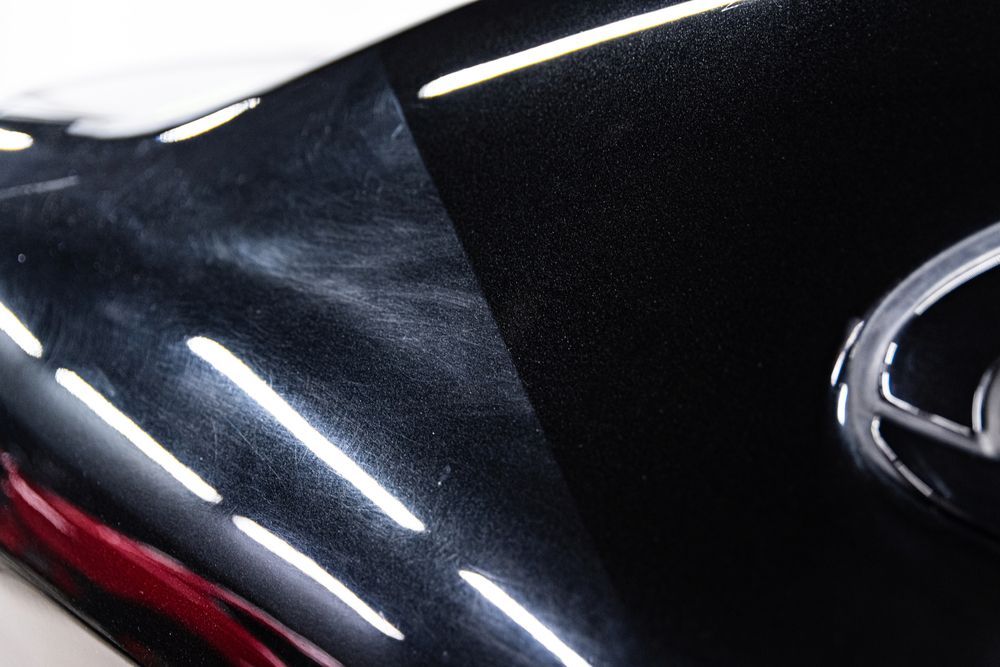
Black paint is one of the easiest places to see the difference. A black vehicle covered in wash marks can look gray, cloudy, or hazy in direct sunlight. Proper correction removes or reduces those defects and allows the paint to reflect light cleanly again, producing the deep, sharp finish people expect from well-maintained black paint.
The same principles apply whether we are working on a daily-driven SUV, a ten-year-old sedan, a weekend Porsche, a classic car, or a supercar being prepared for a show.
Paint Correction Is Not Just a Body Shop Service
Body shops and paint-correction specialists ultimately have different primary jobs. A body shop specializes in collision repair, refinishing, bodywork, and repainting damaged panels. A dedicated paint-correction service is focused specifically on refining the existing finish and achieving the best possible appearance from the paint that is already on the vehicle.
There are excellent body-shop technicians who can finish paint beautifully, just as there are poor detailers who can leave paint covered in machine marks. The difference is not simply the building the work happens in. It is the technician, process, inspection, equipment, and standard of finish being pursued.
At OnPoint, paint correction is not an afterthought before applying a coating. It is one of the core services we want to be known for.
Paint Correction in Morris County, New Jersey
OnPoint Mobile Detail provides professional paint correction throughout Morris County, including Morristown, Chatham, Mendham, Mountain Lakes, Randolph, Montville, Madison, Florham Park, Denville, Rockaway, Boonton, Parsippany, and surrounding North Jersey communities.
We work on daily drivers, luxury vehicles, weekend cars, classics, show cars, enthusiast vehicles, and exotics. Every vehicle is evaluated based on its current condition and the result the owner wants rather than automatically being pushed into a certain number of correction stages.
Forget the Number of Steps—Start With the Paint
You do not need to know whether your vehicle needs a “buff,” one-step correction, two-step correction, or full multi-step correction before bringing it to us.
That is our job to determine.
Show us the paint. Tell us what bothers you about it and what you want the vehicle to look like when we are finished. From there, we can inspect the finish and recommend the appropriate process.
The terminology may have changed from the old days of a simple cut and buff, but the goal has become much more refined:
Remove the defects that can safely be removed, restore the clarity and depth of the paint, and finish the vehicle to a standard worth protecting.